
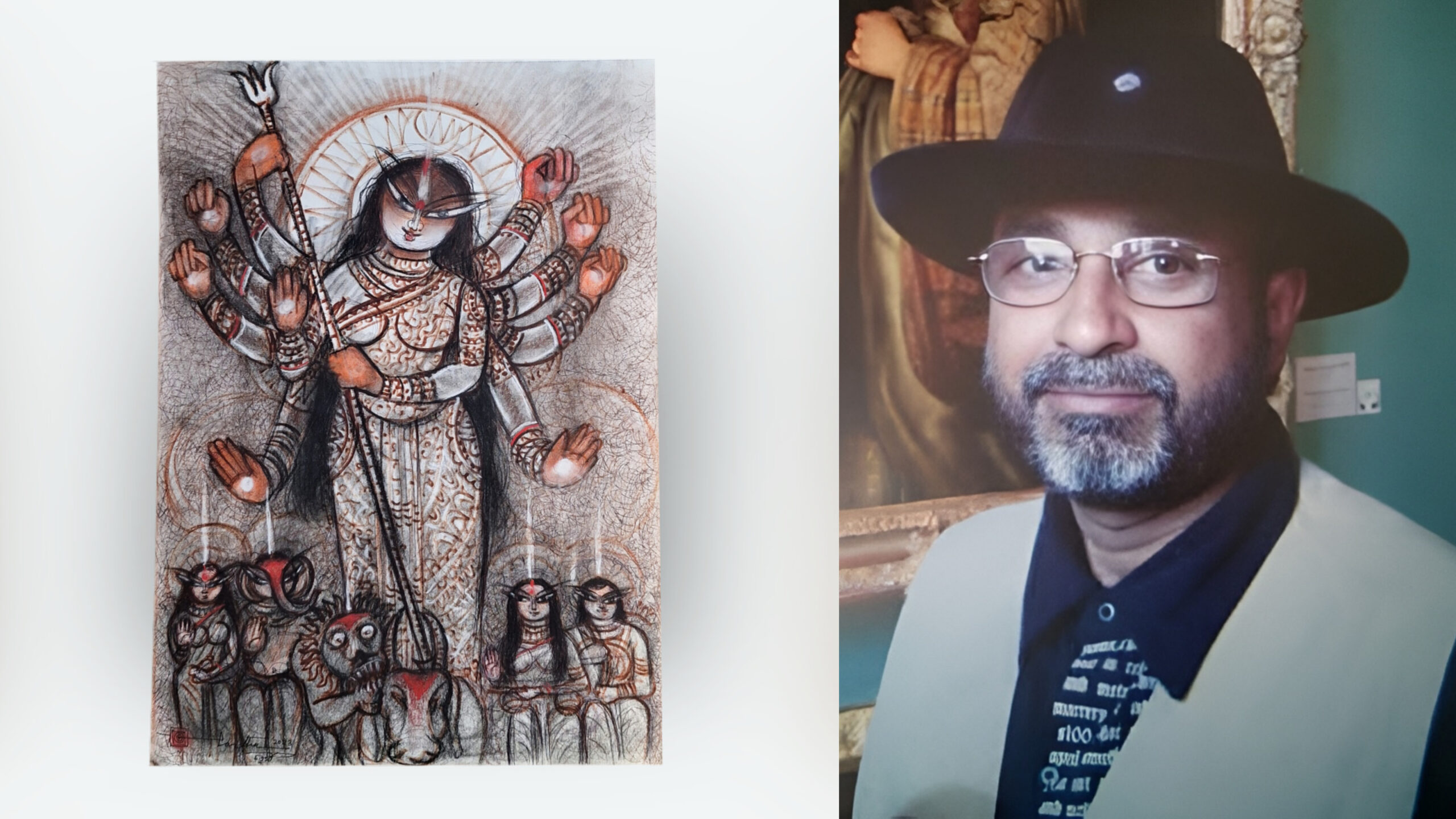
Across four decades of painting, through oil and pastel, through canvas and paper, through clear sight and compromised vision, through poverty and recognition and illness and the approach of the end, artist Partha Bhattacharjee returned again and again to the same subject: the divine feminine, hiding in plain sight inside ordinary life.
This was not a theme he chose. It was a conviction he held — as completely and as quietly as someone holds a truth they have always known and spent their whole life learning to say clearly. The goddess, for Partha, was not a mythological figure or a devotional abstraction. She was present. She was here. She was the woman in every rural courtyard, the woman in the urban market, the woman carrying water or grain or the weight of a world that does not quite see her. Look closely enough at any of them, Partha’s paintings insist, and you will see what he saw.
The Devi Series
The Devi Series of the 1990s was the first full articulation of this conviction. Using Trompe-l’oeil — the Renaissance technique of photographic realism deployed to create optical illusions — Partha placed the divine feminine inside the everyday. The paintings show women in recognizable Indian settings: rural, urban, domestic, public. And within those recognizable settings, through the extraordinary precision of his oil technique, he reveals what he believes to be the deeper reality: the goddess is not behind or above or separate from these women. She is them. The ordinary is the illusion; the divine is the fact.
For this series, he was awarded the President of India’s silver plaque for the best work of 2000-2001 by the All India Fine Arts and Crafts Society — recognition that confirmed what the paintings themselves had already established: that an artist had found the subject he was made to paint.
Partha spoke openly about the pain he felt when he witnessed the conditions in which women lived in his time. The gap between what women are — manifestations of the supreme divine — and how they are actually treated by families, communities, institutions, and systems was, for him, a wound he carried throughout his career. The Devi Series was not political art in the conventional sense. It did not protest or argue in the way that political art usually does. It made a different kind of claim: that the divine feminine is not a figure from mythology but a presence in the world, and that failing to see it is both a spiritual and a moral failure.
Strength and Softness as One
In his final years, after the 2017 cerebral attack redirected him toward dry pastel and the folk idiom of India, the divine feminine returned in the Durga and Mahakal Series. Here, the recurring motif was the Adi Shakti — the primal divine feminine. Durga, the warrior who destroys evil, fierce and uncompromising. Parvati, the devoted consort, gentle and nurturing. Saraswasti goddess of knowledge, music, arts, wisdom, and learning, and Kali goddess who embodies Shakti (divine feminine energy) and is the ultimate representation of time, creation, preservation, and destruction.
Partha tried to capture the two sides of the same divine coin, the protector and the beloved, present in every woman who has ever had to be both at once.
What This Means for Collectors
For those interested in contemporary Indian fine art by Partha that operates at the intersection of the traditional and the innovative, the personally felt and the universally resonant — the Devi and Durga Series offer exactly that. Partha Bhattacharjee made these paintings from a place of genuine belief. They ask to be received in the same spirit: with patience, with attention, and with a willingness to look until you see.