Every year, tens of millions of Indians sit down to prepare for one of the country’s competitive government examinations. They write practice answers. They wait. In the traditional coaching model, that wait stretches across ten to fifteen days before any feedback arrives — handwritten, often generic, rarely specific enough to be acted upon. For an aspirant in a small town without access to a top coaching institute, the quality of that feedback may be weaker still.
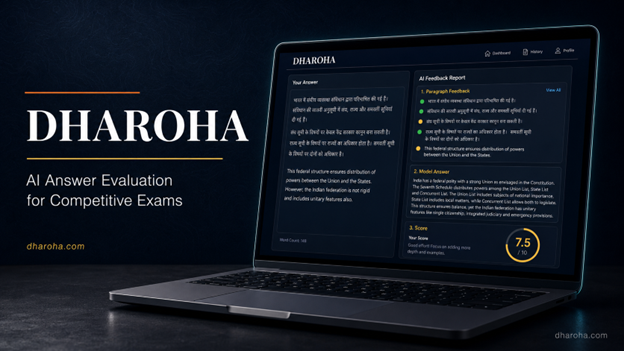
Dharoha — available at dharoha.com — is a live AI-powered answer evaluation platform built to change that. The premise is direct: an aspirant writes a practice answer for any of a wide range of competitive examinations, submits it to the platform, and receives paragraph-level feedback, a model answer, and a score in under sixty seconds. The platform supports Hindi and multiple other Indian languages, making it accessible to a large section of the aspirant population that has historically been underserved by English-only preparation tools.
The problem it addresses
The structural problem in Indian competitive exam preparation is not a lack of aspiration or intelligence among aspirants. It is a lack of timely, specific, and accessible feedback. Quality coaching is concentrated in a handful of cities — Mukherjee Nagar in Delhi being the most prominent — and the cost of accessing it, in fees and in relocation, places it out of reach for a significant portion of those who are preparing.
For those who do enrol, feedback on written answers arrives slowly. The turnaround at most coaching institutes runs to days or weeks. By the time an aspirant receives a response on an answer they wrote, the moment of learning has passed. The feedback, when it comes, is often holistic rather than granular — a general comment on structure or content rather than a line-by-line analysis of where the argument weakened or which key terms were absent.
Dharoha’s response to this problem is built around one core product decision: paragraph-level feedback. Rather than evaluating an answer as a single unit and returning a summary score, the platform analyses the response at the paragraph level — identifying specifically where the writing is strong, where it falls short, and what is missing. This granularity is what makes the feedback actionable rather than merely descriptive.
The goal is to make expert-level feedback available to every aspirant — regardless of geography, language, or income.
What the platform covers
Dharoha currently supports answer evaluation across a comprehensive range of examinations. For UPSC, the platform covers General Studies papers, Ethics, Essay, and Optional subjects. For state-level examinations, it supports UPPSC, MPPSC, and BPSC — three of the largest state public service commission exams in the country by applicant volume. Defence examinations covered include NDA and CDS. The platform also supports SSC descriptive answer papers and RBI Grade B answers, extending its coverage beyond civil services preparation into other high-competition government recruitment streams.
Each evaluation delivers three outputs: a paragraph-level analysis of the submitted answer, a model answer constructed to the appropriate word count and format for the specific exam and question type, and a score. The entire process completes in under sixty seconds.
Language inclusion as a strategic priority
One of Dharoha’s most significant design choices is its support for Hindi and other Indian languages. The Hindi-medium aspirant population represents a large share of the overall UPSC applicant base, and yet the tools available to them — evaluation platforms, feedback systems, model answers — have historically been built almost exclusively in English. The same gap exists for aspirants who prepare in Marathi, Telugu, Tamil, Kannada, Bengali, and other regional languages.
Dharoha’s multilingual capability means that an aspirant who thinks and writes in Hindi can receive feedback in the same language, structured in a way that is directly useful to their preparation. This is not a minor convenience — for a large section of the aspirant population, it is the difference between a tool that is genuinely useful and one that creates an additional barrier between them and their goal.
The broader vision
Dharoha is the second company founded by Nupur Choudhary, who also runs Diztaly, a global AI business transformation company. The two ventures are built on the same underlying principle — that technology should solve real, felt problems for real people, and that access to quality tools should not be determined by geography or income.
For Dharoha, that principle translates into a specific ambition: to become the daily preparation partner for every competitive exam aspirant in India. The current platform — delivering instant, paragraph-level, multilingual feedback — is the foundation. The long-term vision is a complete preparation ecosystem: a question bank drawing from decades of past papers, progress tracking across sessions, community features that allow aspirants to learn from each other, and mentorship connections that are informed by accumulated evaluation data.
The examinations Dharoha supports represent some of the most consequential tests in India — pathways to roles in civil services, defence, banking regulation, and public administration. The aspirants preparing for them deserve preparation tools that match the seriousness of what they are attempting. Dharoha is built with that weight in mind.
Dharoha is live at dharoha.com.