
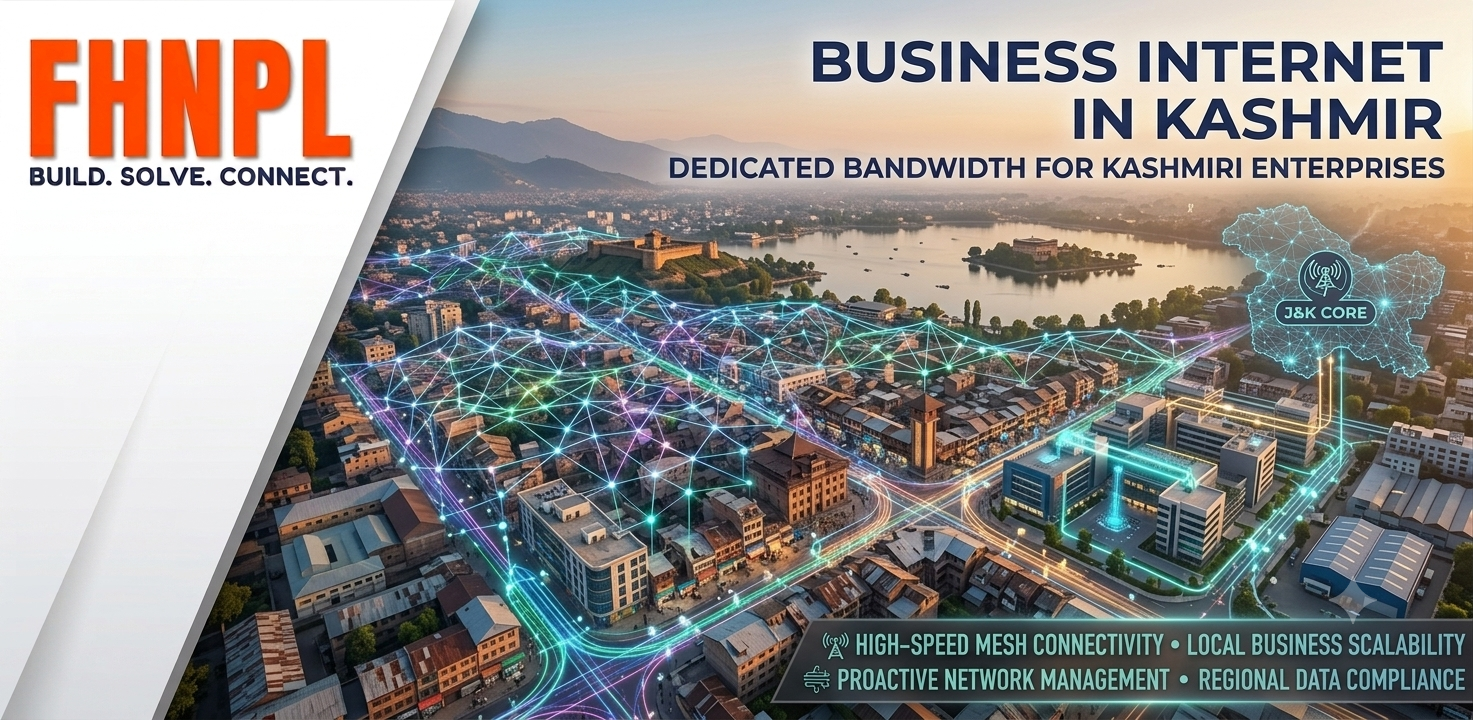
Every business owner in Srinagar, Anantnag or Baramulla has, at some point, been sold an internet plan on the promise of a speed number that never quite materialised once the connection was live. Choosing business internet in Kashmir is less about chasing the biggest advertised number and more about understanding what actually determines day-to-day reliability.
Start With the Licence, Not the Brochure
Under Indian telecom regulation, only a company holding a valid Unified License from the Department of Telecommunications is authorised to provide internet services as an ISP. This single fact should be the first filter a business applies — not the glossiness of a sales brochure. A licensed operator is accountable to DoT rules on service quality, data handling and lawful interception compliance, protections an unlicensed reseller cannot offer.
Match the Product to the Actual Use Case
Business internet is not one product — it spans shared broadband, dedicated wireless, and leased lines, each suited to different risk tolerances. A retail shop running a card machine and a couple of laptops has very different requirements from a hospital running imaging transfers or a bank branch running core-banking terminals.
Shared Broadband vs. Dedicated Bandwidth
Shared broadband is cost-effective and perfectly adequate for lighter workloads, but performance can dip during peak hours because bandwidth is split across multiple users on the same segment. Dedicated options — such as a leased line or a business-grade wireless plan from a Wireless Internet Provider — remove that variability, which matters far more once a business depends on real-time applications like point-of-sale systems or video calls.
Local Infrastructure Beats Distant Promises
A national ISP’s marketing may look identical from Mumbai to Srinagar, but actual service quality depends heavily on how close the operator’s physical infrastructure — towers, dark fibre, points of presence — sits to a customer’s premises. A regional operator that has already built out towers and fibre across the Valley and Ladakh, such as FHNPL, can often resolve faults faster simply because its technicians and infrastructure are already local.
Support: The Difference Between a Call Centre and a Real Number
Ask any Kashmir-based business what frustrates them most about ISPs, and “support that actually picks up” ranks near the top. A single point of contact reachable by call, SMS or WhatsApp, with a defined callback commitment, is a far more practical support model in a region with connectivity variability than a distant, ticket-based call centre.
Questions Worth Asking Before You Sign
Before committing to a contract, a business should ask: Does the provider hold a current DoT Unified License? What is the SLA for uptime and fault resolution? Is the last mile fibre-backed or purely wireless relay? What does support actually look like on a bad-weather day? Answering these honestly will tell a business more than any speed test ever will.
Bundling Connectivity With Security and IT Support
An increasing number of Kashmir-based businesses are choosing providers who can bundle internet access with cybersecurity, managed IT and even website development under a single relationship, rather than juggling separate vendors for each. A Business Internet Solutions partner that already understands a customer’s network can typically respond to a security incident or an IT issue faster than a third-party vendor coming in cold, simply because the underlying infrastructure is already familiar to them.
The Cost of Getting This Decision Wrong
Businesses that choose purely on advertised price often discover the real cost later, in the form of missed transactions, frustrated customers, and hours spent on hold with a support line that cannot dispatch a technician quickly. Factoring in the cost of downtime, rather than just the monthly bill, changes the calculation considerably — and usually points toward a provider that can demonstrate real infrastructure and a responsive local team over one offering only a marginally lower rate.
Conclusion
Business internet in Kashmir is ultimately a reliability decision disguised as a speed decision. The businesses that end up satisfied a year later are rarely the ones that chose the cheapest plan — they are the ones that matched the right product to their actual risk, verified the provider’s licensing, and confirmed that support was a real, local, reachable team rather than a distant script.
Frequently Asked Questions
Q: What license should a business internet provider in Kashmir hold?
A: A Unified License issued by the Department of Telecommunications, Government of India, is the baseline requirement for a legitimate ISP.
Q: Is shared broadband enough for a small business?
A: For lighter workloads such as browsing, email and occasional video calls, shared broadband is often sufficient, though performance can vary during peak hours.
Q: When should a business upgrade to a dedicated connection?
A: When downtime directly affects revenue, safety or compliance — such as banking, healthcare or continuous video surveillance — a dedicated wireless or leased-line connection is worth the investment.
Q: How important is local support for a Kashmir-based business?
A: Very important. Local support teams typically respond faster to on-ground issues like tower faults or fibre cuts than a distant national call centre.
Q: Can one provider offer both internet and cybersecurity services?
A: Yes, several regional ISPs now bundle connectivity with cybersecurity, managed IT and cloud services under one contract.
Q: What should I check about a provider’s infrastructure?
A: Ask whether their base stations are backed by dark fibre and how many districts they actively serve — this indicates real, on-ground infrastructure rather than resold capacity.
Call to Action
Comparing business internet options in Kashmir? Request a free consultation and site survey to see which connectivity option — broadband, wireless or leased line — actually fits your operations. Visit fhnpl.com and follow along on Facebook, X (Twitter) and Instagram.
Learn more: fhnpl.com | Facebook | X (Twitter) | Instagram