
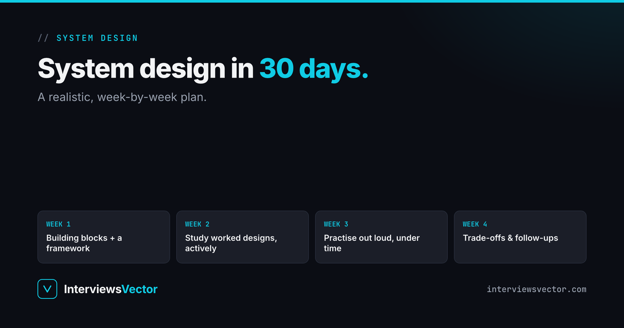
System-design interviews intimidate people because they feel unbounded — there is no single algorithm to memorise, and the problems (“design a URL shortener,” “design a news feed”) seem to invite infinite answers. The good news is that fluency is far more learnable than it looks. In about a month of deliberate practice, most engineers can go from freezing at a blank whiteboard to running a confident, structured discussion. Here is a realistic plan.
Week 1: Learn the building blocks and a framework
You cannot design systems until you have the vocabulary of parts. Spend the first week getting genuinely comfortable with the core components and what they trade off: load balancers, caches, relational versus non-relational databases, replication and sharding, queues, and content delivery networks. For each, you should be able to say what it does, when you would reach for it, and what it costs you.
At the same time, adopt a repeatable framework so you never face a blank canvas. A reliable one: clarify requirements, estimate scale, define the API, sketch a high-level design, then go deep on one or two components and their bottlenecks. Practising a structured system-design roadmap in week one means every later problem slots into the same reassuring shape.
Week 2: Study worked designs — actively
Now apply the vocabulary to real problems. Work through the classic designs — a URL shortener, a rate limiter, a chat system, a news feed, a file-storage service — but study them actively, not passively. Reading a solution teaches you almost nothing; the learning happens when you pause before the answer and try to design it yourself first, then compare.
The goal is not to memorise these systems so you can regurgitate them. It is to build a library of patterns — how caching solves read-heavy load, how a queue absorbs spikes, how sharding trades simplicity for scale — that you can recombine on a problem you have never seen. Good worked case studies to learn from are most valuable when you treat each one as a puzzle to attempt before it is an answer to absorb.
Week 3: Practise out loud, under time
This is the week most people skip, and it is the one that matters most. A system-design interview is a spoken performance, and reasoning out loud is a separate skill from reasoning in your head. Set a timer for 40 minutes, pick a problem, and talk through the entire design as if someone were listening — ideally because someone, or something, is.
Force yourself to narrate the framework: state your assumptions, do the back-of-the-envelope math on scale, justify each component out loud, and name the trade-offs as you make them. Record yourself or practise with a partner. You are training the muscle that turns a good mental model into a clear, followable conversation — the thing interviewers actually score.
Week 4: Deepen trade-offs and rehearse the follow-ups
By the final week, the shape of a design should feel automatic, so shift your attention to depth. Interviews are won or lost in the follow-up questions — “what happens when this database becomes the bottleneck?”, “how do you keep the cache consistent?”, “what breaks at ten times the traffic?” Spend this week deliberately pushing into those second-order questions on every problem.
Focus on the recurring tensions: consistency versus availability, latency versus throughput, read-optimised versus write-optimised. Being able to discuss these fluently is what makes you sound like an engineer who has operated systems, not just read about them. A guided prep path helps here by sequencing the harder trade-off discussions after the fundamentals are solid, rather than all at once.
A few rules that make the month work
Consistency beats intensity: 45 focused minutes a day for 30 days will take you further than three exhausting weekends. Always attempt before you study the answer, because the struggle is the learning. And prioritise breadth of patterns over depth on any single system — the interview will hand you a problem you have not seen, and your job is to recombine what you know, not recall a script.
The bottom line
Thirty days is enough because system-design fluency is not about memorising a hundred architectures. It is about internalising a small set of components, a repeatable framework, and the trade-offs between them — then practising the reasoning out loud until it flows. Do that for a month and the blank whiteboard stops being intimidating and starts being an invitation.