
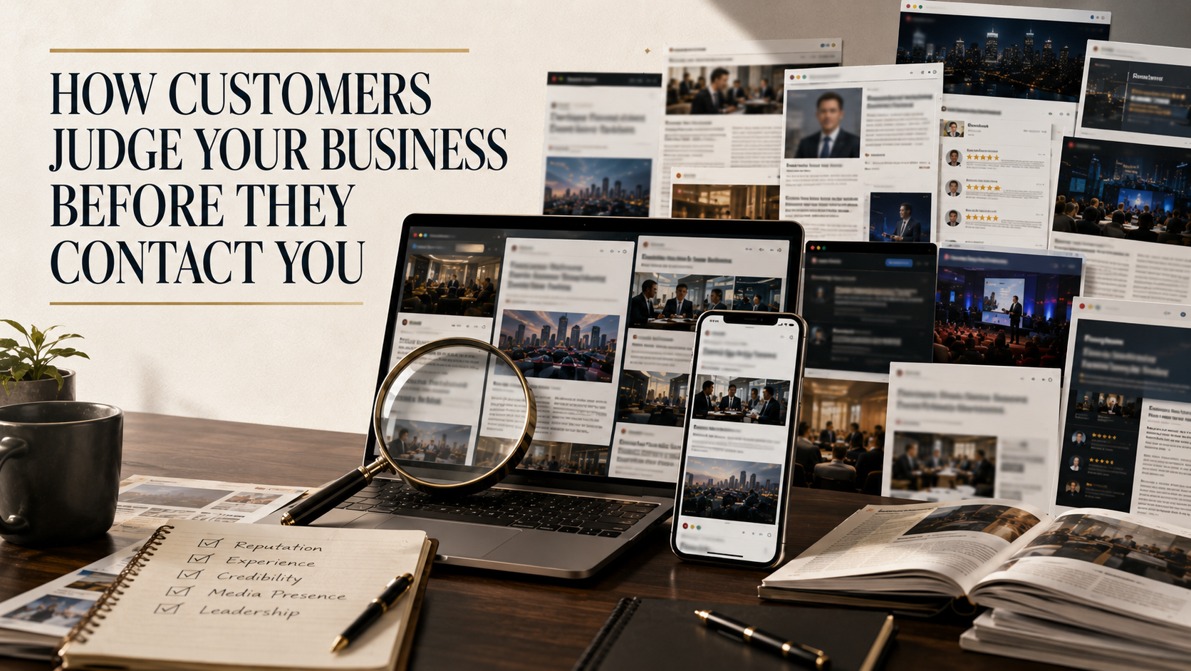
Long before a customer fills out an enquiry form, makes a phone call, or schedules a meeting, something important has already happened. They’ve started forming an opinion. According to branding and public relations professionals, that judgment often takes place quietly—through search results, media coverage, online presence, and the overall digital footprint a business has built over time. By the time the first conversation begins, many buying decisions have already started taking shape.
Imagine being introduced to two companies.
One has a professional website, a few social media posts, and little else.
The other appears in business publications, shares expert insights, has meaningful media coverage, and shows evidence of steady growth through credible online content.
Without speaking to either company, most people naturally assume one feels more established than the other.
That reaction isn’t accidental.
It’s human psychology.
According to professionals at Spatz Media, customers rarely evaluate businesses based on a single factor. Instead, they gather small pieces of information from multiple sources and subconsciously combine them into an overall impression. Every article they read, every news mention they discover, every founder interview they watch, and every business milestone they encounter becomes another signal helping them answer a simple question:
“Can I trust this company?”
Interestingly, businesses often spend enormous effort preparing for sales meetings while overlooking everything customers see before those meetings ever happen.
Today’s buying journey usually begins with a search engine.
A potential client may search the company name.
The founder’s name.
Customer reviews.
Industry reputation.
Recent news.
Business achievements.
Or simply look for evidence that the organization is active and credible.
Those few minutes of research frequently become a company’s first impression.
And first impressions are surprisingly difficult to change.
Behavioral psychologists have long observed that people naturally look for evidence that reduces uncertainty before making decisions. Choosing a business involves risk. Customers wonder whether they’ll receive good service, whether promises will be fulfilled, and whether they’re making the right choice. Every positive signal they discover helps reduce that uncertainty.
Visibility creates familiarity.
Familiarity encourages confidence.
Confidence influences decisions.
This explains why many businesses notice that prospects already seem comfortable during the very first conversation. They haven’t built that comfort in a single phone call. They built it gradually through consistent visibility long before direct contact occurred.
According to industry specialists at Spatz Media, one of the strongest trust signals comes from credible media coverage. When businesses consistently share meaningful stories, industry insights, innovations, partnerships, awards, research, and business milestones, they create a public record of progress that customers can easily discover.
One article may spark curiosity.
Another reinforces legitimacy.
Several together begin creating authority.
Over time, those stories become part of the company’s reputation.
Another psychological principle that quietly shapes customer behavior is consistency. People naturally assume that businesses which communicate regularly are active, evolving, and committed to their industry. Long periods of silence, on the other hand, may unintentionally create uncertainty—even if the business itself is performing exceptionally well behind the scenes.
The market can only judge what it can see.
Outstanding work that remains invisible rarely contributes to reputation.
This doesn’t mean businesses should publish content simply to stay visible.
Every communication should have purpose.
Every story should add value.
Every media appearance should contribute something meaningful to readers.
According to professionals at Spatz Media, this is why effective public relations focuses on relevance rather than publicity alone. Businesses strengthen their reputation by consistently sharing stories that educate, inform, or demonstrate genuine progress instead of repeatedly promoting themselves.
People trust expertise more than promotion.
They remember useful information longer than marketing slogans.
Another factor influencing customer psychology is social proof. When prospective clients repeatedly encounter a business across respected media platforms, they begin seeing evidence that others have recognized the company’s work. While readers understand that media coverage does not automatically guarantee quality, consistent appearances across credible publications often reinforce the perception that the business is established, active, and engaged within its industry.
This is why reputation grows gradually.
Not through a single headline.
But through a series of positive encounters that accumulate over time.
Experienced PR professionals often describe this as building a digital reputation library. Every credible publication becomes another chapter that future customers may discover while researching the business. Some readers may find only one article. Others may explore several. Regardless of how much they read, each story contributes another layer to the overall perception they form before making contact.
By the time the first email arrives or the first meeting begins, customers are often not evaluating a blank slate.
They are evaluating the reputation they have already discovered.
According to Spatz Media, businesses that consistently invest in meaningful communication understand an important reality. Customers don’t begin judging a company when the conversation starts. They begin much earlier, often without the business even knowing it. Every positive story, every credible publication, every thoughtful insight, and every visible achievement quietly shapes that judgment, making future conversations easier because trust has already started to develop.
Perhaps that’s why branding and public relations are no longer viewed simply as marketing activities.
They have become part of the customer’s decision-making process.
Businesses interested in understanding how strategic public relations influences customer perception, trust, and long-term brand credibility can explore additional educational resources published by Spatz Media (https://spatzmedia.com/), where the focus remains on helping organizations build lasting reputations through relevant, consistent, and credibility-driven communication rather than one-time publicity campaigns.