
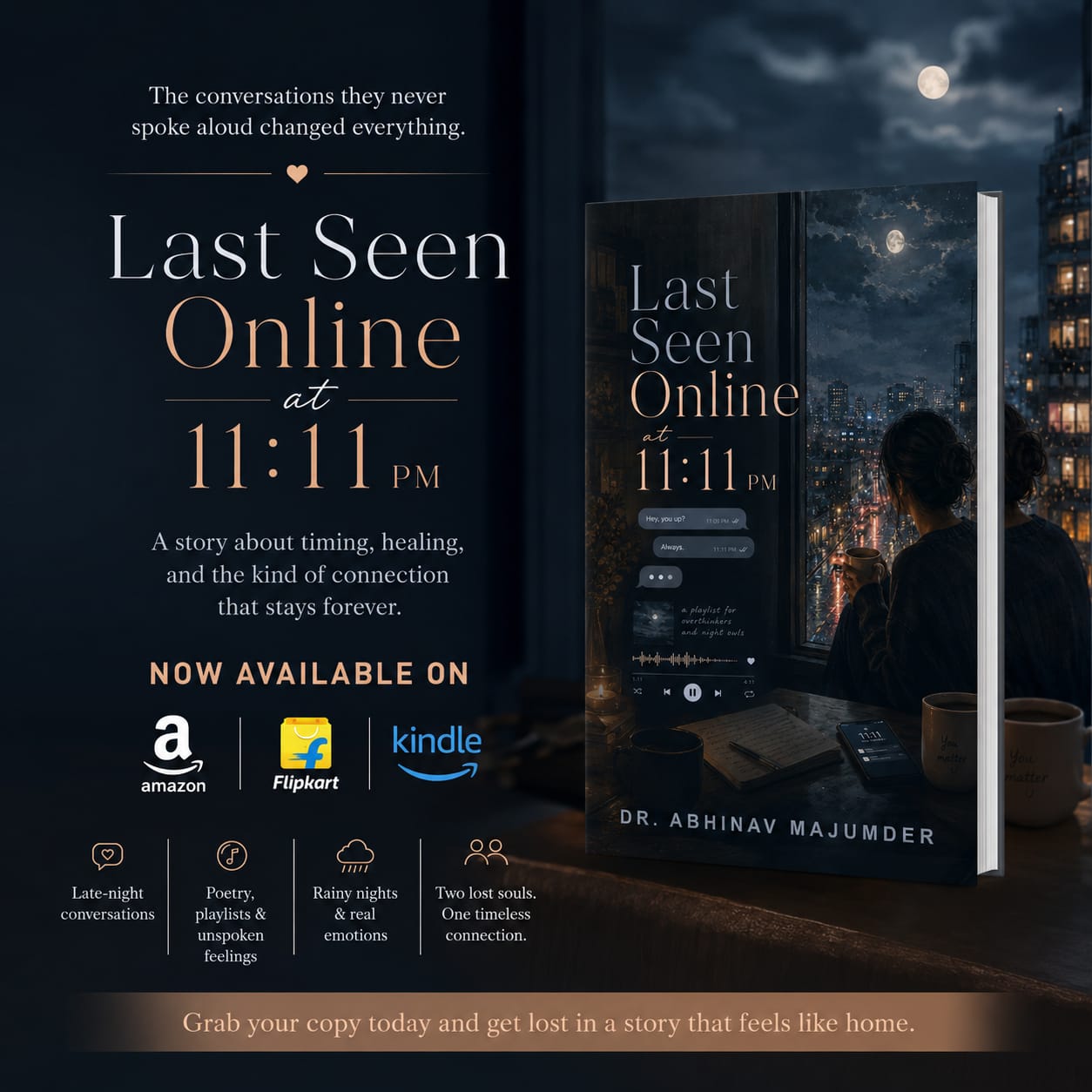
Published by SPI Publications, Dr. Abhinav Majumder’s fiction debut is finding a growing readership through its intimate portrayal of modern love, late-night conversations, music, poetry, digital connection and the memories that refuse to disappear.
Some stories are simply read. Others linger long after the final page is turned. Dr. Abhinav Majumder’s debut fiction novel, Last Seen Online at 11:11 PM, published by SPI Publications, is increasingly becoming one of those stories. The novel is generating growing interest among readers and conversations across social media and literary circles for its deeply intimate portrayal of love, emotional companionship, nostalgia and healing in an age where relationships often begin and evolve through screens.
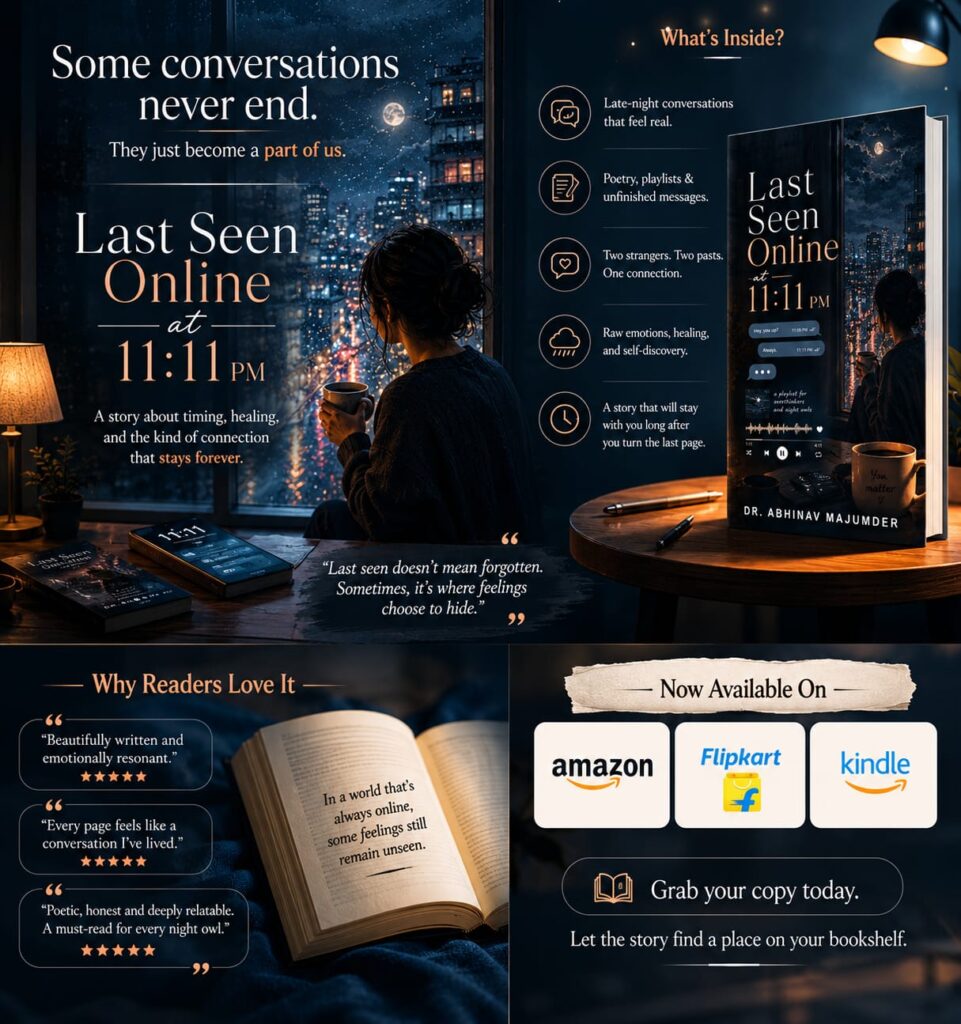
For Majumder, the novel marks an important new chapter in an already evolving literary journey. Having previously explored poetry anthologies and non-fiction, he now enters the world of fiction with a story that feels remarkably close to the emotional reality of contemporary relationships. Here, romance does not necessarily begin with a dramatic meeting or a cinematic moment. It can begin with a notification, a message sent late at night, a song shared between two people, or a conversation that unexpectedly continues until the world around them has gone quiet.
At the heart of Last Seen Online at 11:11 PM is a story about love in the digital age, but its emotional core extends far beyond technology. The novel explores how two people can begin as strangers behind screens and gradually become deeply significant to one another. Through late-night conversations, poetry, playlists, vulnerability and emotional companionship, the story enters the delicate space where digital connection begins to feel profoundly human.
That emotional familiarity appears to be one of the reasons the novel is resonating with readers. The experiences it draws upon are instantly recognizable to anyone who has waited for a particular message, noticed a person’s last seen status, replayed a song because it reminded them of someone, or stayed awake longer than they intended simply because a conversation felt too important to end. What might appear to be ordinary elements of digital life become, within the novel, symbols of longing, attachment, uncertainty and the difficult process of letting go.
From Poetry to Fiction, From Pages to Conversations
Majumder’s transition from poetry and non-fiction into fiction has added another layer of interest to the book. Readers familiar with his earlier literary work have welcomed the shift, while the novel has also opened his writing to audiences drawn toward contemporary romance and emotionally driven storytelling.
The growing conversations surrounding Last Seen Online at 11:11 PM revolve around themes that define relationships for an increasingly digital generation: modern romance, emotional intimacy, online relationships, nostalgia, vulnerability and healing. Rather than presenting these ideas from a distant perspective, the novel places them inside experiences that feel personal and familiar.
Perhaps that is where its emotional strength lies. The story does not require readers to imagine an entirely unfamiliar world. Instead, it takes pieces of everyday digital life and gives them emotional weight. A notification becomes anticipation. Silence becomes uncertainty. A playlist becomes memory. A conversation becomes a relationship. And a timestamp becomes a place where an entire chapter of someone’s life can remain frozen.
In a world where relationships increasingly exist across both physical and digital spaces, the novel explores a question that can be both beautiful and painful: what happens when someone who once made your phone light up eventually becomes a memory, yet the smallest reminder can still bring that entire relationship back?
Why 11:11 Matters
Even the title carries an emotional mystery of its own.
The time 11:11 has long been associated with wishes, synchronicities and moments that seem to carry a significance beyond their ordinary appearance. In Last Seen Online at 11:11 PM, that familiar timestamp takes on a much more intimate meaning. It becomes more than a time displayed on a screen. It becomes a moment capable of holding an entire emotional universe.
For readers who have ever attached a memory to a particular hour, message, song or conversation, the title can feel immediately personal. It captures the strange way certain moments remain preserved in our minds long after the circumstances surrounding them have changed.
One timestamp can carry a conversation. One conversation can carry a relationship. And one relationship can leave behind memories that refuse to disappear.
That idea gives Last Seen Online at 11:11 PM an identity that extends beyond the conventional boundaries of a romance novel. It becomes a story about the digital traces people leave behind and the emotional traces they carry within themselves.
A Love Story That Feels Familiar
With its blend of romance, poetry, music and digital-age nostalgia, the novel speaks to readers who understand that modern love is often made up of seemingly insignificant moments that become unforgettable later. It is for anyone who has stayed awake for one particular conversation, associated a particular song with one particular person, waited for one particular notification, or wondered how life might have unfolded if two people had met at a different moment.
There is something deeply universal about that feeling. Most people carry at least one memory that can be unexpectedly reopened by a song, a photograph, a name, a message or even a particular time on a clock. The novel taps into that emotional space and transforms those familiar experiences into fiction.
This may explain why the growing response to Last Seen Online at 11:11 PM feels less like a conventional reaction to a new book and more like readers recognizing fragments of their own lives within its pages.
The novel’s emerging appeal lies in that delicate space between fiction and memory. It tells a fictional love story, yet the emotions it explores can feel strikingly real. Readers may recognize the excitement of connection, the comfort of being understood, the uncertainty of waiting, the ache of distance and the quiet process of healing after something meaningful has changed.
Ultimately, Last Seen Online at 11:11 PM is a story about what remains after a relationship moves beyond the present moment. People may stop talking. Conversations may end. Notifications may disappear. But memories have a way of remaining active long after someone has gone offline.
As Dr. Abhinav Majumder’s fiction debut continues reaching readers through recommendations, reviews and social media conversations, its central idea becomes increasingly poignant: in an age where almost everything can disappear with a swipe, some emotions continue to stay with us.
Some stories go offline. Their memories do not.
Last Seen Online at 11:11 PM, published by SPI Publications, is available through major book platforms including Amazon, Flipkart and Kindle